

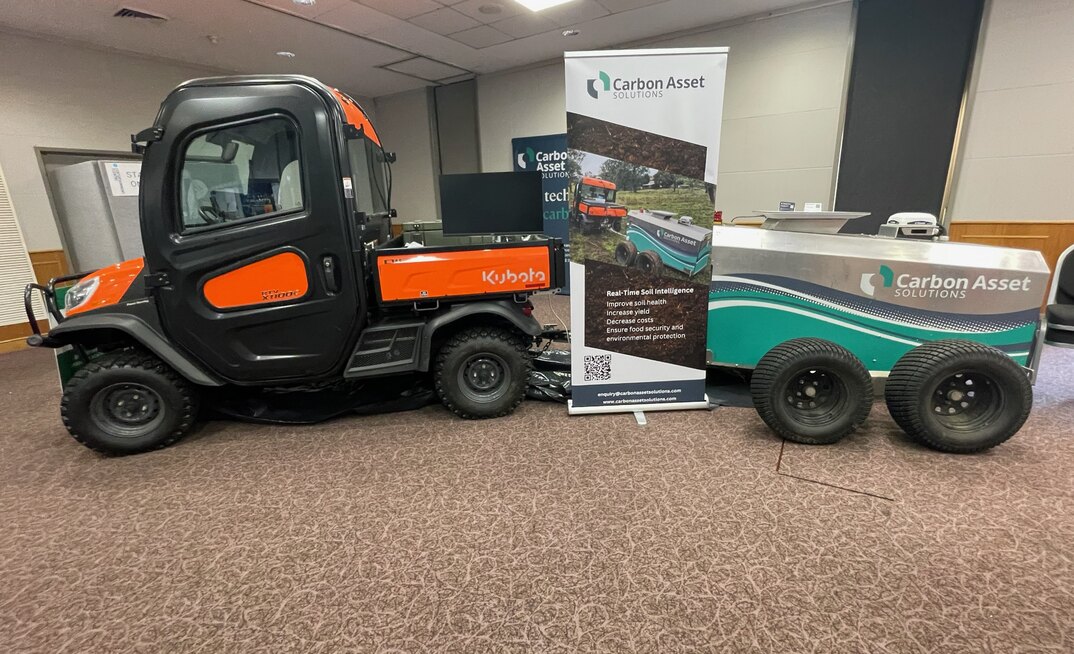


MEASURING soil carbon usually involves a somewhat labour-intensive process of collecting soil samples from a paddock.
Soil core samples are then delivered to a laboratory for testing and measuring various parameters and elements.
However, a new sampling method which does not disturb the soil was on show at the National Carbon Conference and Expo held in Albury, New South Wales recently.
Known as Mobile Inelastic Neutron Scattering or MINS, the soil measuring system is run in a small trailer towed behind a side-by-side.
YOU MIGHT ALSO LIKE
Hamish Macdonald, managing director, Carbon Asset Solutions, who owns the exclusive global commercialisation rights to MINS, said the system (developed by the United States Department of Agriculture) is able to map total soil carbon content to a depth of 300mm.
"The MINS is basically a neutron generator that emits neutrons into the ground that ‘excite' molecules in the soil," Macdonald said.
"Three gamma detectors on the unit pick up the resultant ‘excitement' continuously and that data is uploaded every 30 seconds by satellite uplink into the CAS cloud software to be stored and processed".
"It's measuring soil properties at the molecular level."
Macdonald said MINS is up to 80 per cent more accurate than traditional soil sampling methods and has been tested against physical soil sampling as well as being peer reviewed.
"The data gathered is also GPS and time-tracked so we can provide maps of various overlays and properties like silica levels, potassium levels and bulk density."
Macdonald hopes the technology will be able to map soil to a depth of 1m next year. The current setup provides a 1.5m swath width and ground speed in ideal conditions is 5-6km/h.
Other developments being worked on include software development for CANBUS links, to allow for prescription delivery maps (like fertiliser). The MINS equipment has auto path and auto speed which means the operator in the towing vehicle does not need to worry about driving.
"At 5km/h the system can cover about 260ha a day and we are also working on increasing daily volumes."
Macdonald has corporate clients for the MINS which include the US Department of Defence, to monitor soil conditions for quality assurance purposes.
Carbon Asset Solutions is hoping to offer the MINS as a fee-for-service for soil health, which supports the upcoming mandatory Scope 1 and 2 reporting requirements for the National Greenhouse and Energy Reporting Scheme. Macdonald said pricing ranges between $40 and $55/ha dependent on property size. Additional services include Greenhouse Gas accounting/reporting and co-benefits assessments.
For more details, visit: https://carbonassetsolutions.com