

This article is 7 years old. Images might not display.
The partnership has seen the integration of FluroSense with Landmark's Echelon program in an effort to help on farm decision making.
An example of how the partnership may benefit farmers is that it allows growers and agronomists to collect accurate and bespoke data gathered from satellite and drone sensors, and better use this data to allow informed decisions on key inputs such as nitrogen.
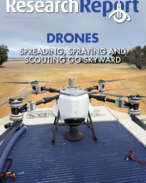
Trials conducted over the past two years in a number of grain regions across Australia helped to measure and analyse nitrogen and other key crop nutrient deployment using multi-spectral imaging and the FluroSense analytics platform.
These trials have helped to determine how much of an impact the fertiliser has on the crop's growth, which will then be correlated to the responding yield, helping improve results over time.
Anastasia Volkova, chief executive officer of FluroSat explained that the partnership would allow farmers to accurately measure which parts of their fields had insufficient, sufficient and surplus nitrogen.
"At its core, FluroSense helps farmers to begin to make better informed decisions by utilising data gathered with incredible accuracy," Volkova said.
"This allows farmers to make small savings per hectare, which can result in a massive difference at scale. For the first time, farmers can accurately measure the impact of different nitrogen levels across their crop. They'll be able to then apply the right amount of fertiliser at the right place in order to get the best possible yields, and also not waste fertiliser where it won't make a major difference."
Senior agronomist at Kerin Landmark Rural, Steve Richmond, said that the technology is ready to deliver huge efficiencies for grain farmers across Australia.
"The job of an agronomist and of growers is complex when it comes to applying fertiliser," Richmond said.
"We're constantly solving a puzzle that has three factors to consider: are we using enough nitrogen, are we putting it in the right place and are we doing it at the right time?
"With technology like FluroSense, which uses non-visible light waves to analyse a field, we can begin to piece together the puzzle sooner and start to use the data to inform where, when and how much fertiliser is needed to maximise profitability."