
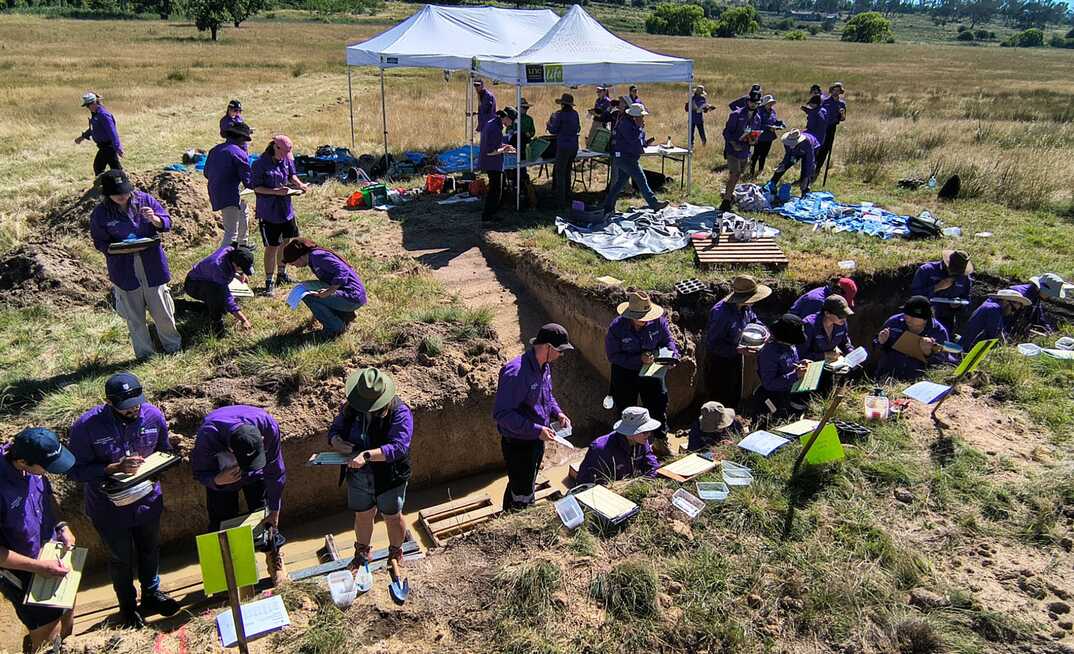


THE national cohort of Regional Soil Coordinators recently travelled to Armidale, New South Wales, to join the annual Soil Judging Competition hosted by Soil Science Australia.
The gathering, held at the University of New England (UNE), involved more than 220 people from 11 countries in 35 teams. Competitors included students, early-career professionals, academics, consultants, and volunteers.
Soil judging is first and foremost a soil classification competition where participants describe, classify and interpret soil profiles in the field. The contest promotes practical training, exposure to different soil types and networking across students, early career professionals and experienced soil scientists from around Australia and abroad.
Leading up to the competition, there were two days of training, held across eight soil pits on UNE's farms. The soil pits represented a range of soil types, landscapes and land-use histories, offering a rich learning environment for participants with varied experience.
Teams were able to build confidence through texture testing, horizon identification, classification and landscape interpretation.
The overall winner of the South Pacific Region Trophy was the Soil Sleuths team from South Australia that also won the Walker Family Trophy for the best team of early career professionals.
The Bennison Family Trophy for an Australian University went to the University of Sydney (undergraduates).
Numerous soil characteristics are assessed in the process of classifying a soil type including:
• Site – landform, slope, parent material (formation), surface condition; and
• Soil profile – horizons (layers), texture (ratio of sand, silt and clay), colour, structure, drainage, slaking, dispersion and pH.
The soil profile is then classed according to the Australian Soil Classification. Available water capacity and soil erosion calculations are conducted, and land suitability assessments are made based on the range of results.
Soils are complex and multi-dimensional. The soil on the surface is typically quite different to soil throughout the depth of the profile. Looking at the soil profile to depth and classifying soils allows the identification of potential constraints and facilitates management decisions associated with varying water and nutrient dynamics.
Soil classification groups soils based on measurable properties throughout the profile, providing a standardised language for comparison across regions or farms. The classification helps predict whether research or management practices will apply locally and can provide insights into how subsoil characteristics influence root-zone conditions and plant growth.
Full details of the competition and winners can be found here: https://tinyurl.com/4axw7hec