
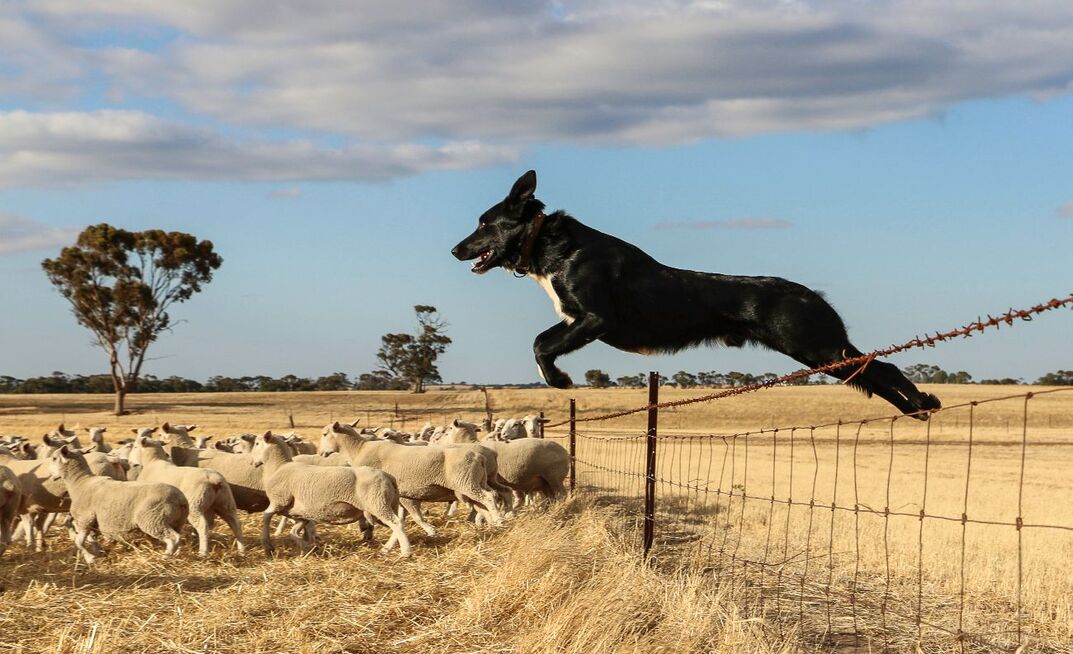


WHILE livestock producers have long understood the value of Australian working dogs, a recent estimate suggests they contribute a whopping three billion dollars to the national economy each year.
Research funded by AgriFutures Australia in 2015 suggested working dogs provide a five-fold return on investment to farmers, but the recent multi-billion estimate by ANZ bank looked at their wider contribution to the economy.
ANZ executive director for food, beverage and agribusiness, Michael Whitehead and ANZ senior writer, Alicia Muling, explained the figure is based on modelling, with the estimate providing "conservative, defendable assumptions using industry data on labour costs, livestock productivity and measurable downstream impacts."
In an article on the subject, they said labour savings made up the largest part of that figure.
YOU MIGHT ALSO LIKE
According to the article, agricultural industry estimates suggested there are likely over 270,000 working livestock dogs in Australia – and possibly many more.
Based on the number of working dogs in use, and industry estimates of how much labour they replace, the article said the dogs likely saved Australian producers around $800 million each year in wages alone.
"That's before factoring in the additional savings they bring by reducing the need for fuel and vehicle use, which is estimated at another $100 million annually. A dog can cover ground that a ute or motorbike can't – and do it without fuel, noise or mechanical wear," the article said.
Their impact on animal outcomes was also significant, with calm, confident dogs found to improve livestock handling, reducing stress on sheep and cattle.
"That translates to better lamb survival rates, improved meat quality and cleaner fleeces – potentially contributing an estimated $150 million each year in added value," the article said.
"On top of that, the daily operational efficiencies working dogs deliver – from faster mustering to smoother yard work – are estimated to contribute at least another $100 million a year, in saved farmer time."
Furthermore, in many operations, especially larger ones, dogs enabled farmers to run bigger herds with the same or even fewer staff, with ANZ saying that increased capacity added to national production and accounted for an estimated $250 million a year in extra livestock output.
"Beyond the farm gate, the benefits continue. More efficient livestock production helps keep meat and wool prices lower for consumers – a flow-on benefit equivalent to around $400 million a year," the article said.
"Meanwhile, the pet and veterinary sector earns over $100 million annually from food, health and gear for working dogs.
"Breeders and trainers contribute another $50 million, with well-trained dogs often fetching five-figure sums at auction."
The value of livestock dogs also showed up in land valuations, workplace safety, rural tourism and regional employment, according to the article. It said farms that are more productive and efficient tended to be worth more, and well-trained dogs supported safer livestock handling by reducing the physical strain and risk involved in mustering and yard work.
"Events like sheepdog trials attract thousands of visitors each year, while skilled dog handling has become part of Australia's rural identity – both culturally and commercially," the article said.
"Taken together, these impacts conservatively add up to more than $3 billion every year.
"The estimate doesn't count every possible saving or benefit – just the ones that can be reasonably modelled.
"What it does show is that working dogs don't just make livestock farming easier. In many cases, they make it possible."
With skilled working dogs potentially saving producers tens of thousands of dollars each year in labour costs alone, the article added "It's little wonder, then, that elite working dogs now command serious money."
It noted a kelpie from New South Wales fetched $49,000 in 2022 – a world record for a working dog. While most trained dogs sell for less, the article said it was now common for dogs to fetch five-figure prices at major auctions.
"To the buyer, that price reflects more than just pedigree or polish. It represents years of training, day-in-day-out dependability, and the ability to turn time, terrain and temperament into tangible productivity gains," it said.
The article concluded the Australian sheepdog was more than a rural tradition – it was a vital part of the modern livestock economy. And it added working dogs were also a reminder that not every valuable asset is a piece of machinery.
"Some of the most important tools in agriculture come with four legs, sharp instincts and an unshakable work ethic," it said.
Read the full article here.