


The 'BlacklegCM' webinar, which will be held on 31 March, will also discuss how to increase the probability of an economic return from fungicide application by using the BlacklegCM app, a tool designed to help determine the best and most profitable management strategy to reduce disease and increase profits.
The webinar event has been organised as part of a Grains Research and Development Corporation (GRDC) investment that aims to deliver disease management tools and targeted risk information.
Steve Marcroft, of Marcroft Pathology and Department of Primary Industries and Regional Development (DPIRD) principal research scientist Art Diggle will host the webinar event.
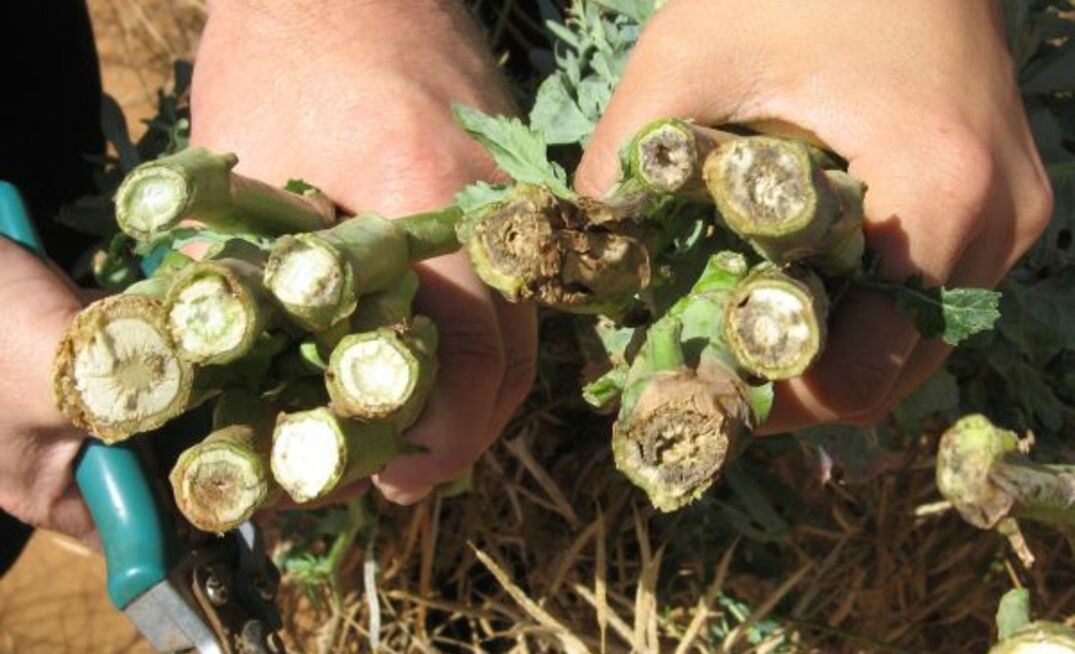
Project leader, DPIRD senior research scientist Jean Galloway, said the webinar would update growers and advisors about blackleg, caused by the fungus Leptosphaeria maculans, and highlight the different management strategies for additional and early sowing.
"It will be a timely opportunity to remind participants about the BlacklegCM app, which enables the user to compare the likely economic outcome of various strategies applicable to their own circumstances, such as paddock selection, variety choice, seed dressing, banded fungicide and sprayed fungicide," Galloway said.
Marcroft said he had received many queries recently from growers and advisors seeking advice on what to do in order to best manage blackleg in their own circumstances, particularly around whether to apply foliar fungicides early in the season.
"If growers were sowing a canola variety highly resistant to blackleg and that had a seed treatment applied, it was likely no economic return would be achieved by applying a fungicide at the four to eight-leaf stage," Marcroft said.
"The trend towards early sown canola crops meant crops were more likely to flower early and this in turn meant they were more vulnerable to upper canopy infection from blackleg.
"Nonetheless, sowing early means the severity of the traditional blackleg crown canker is likely to be reduced at earlier growth stages.
"This change in the farming system means a seed-dressing may not be required, and it is less likely that there'll be an economic return from a foliar fungicide application at the four to eight-leaf stage.
"However, monitoring for blackleg upper canopy infection later in the season is recommended, as earlier sowing and the subsequent earlier date to the first flower may result in increases upper canopy infection," Marcroft said.
The BlacklegCM webinar will be held on Wednesday 31 March, from 11:30am to 12 noon AEST.
To register, visit https://dpird.zoom.us/webinar/register/WN_B8rb_7xaS7yhq5ajht0GhA