

Having setting out the very broad elements of a business case for carbon farming, the remainder of this manual drills down into each of the elements of the business case in considerably more detail.
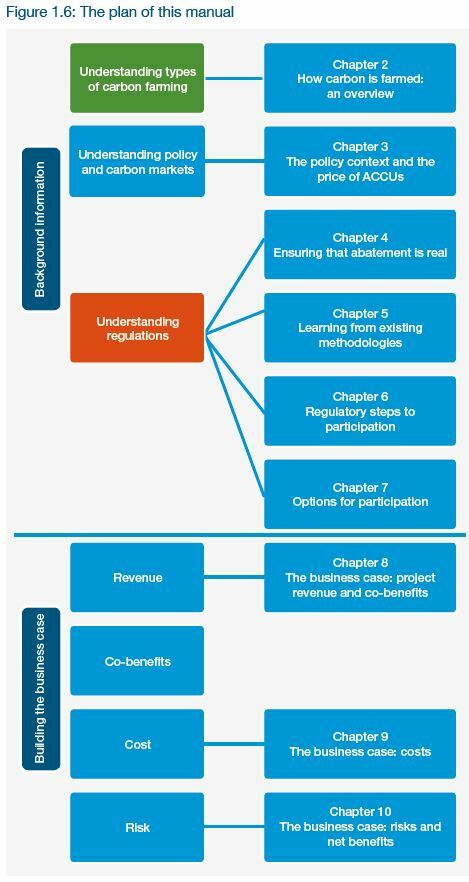
Figure 1.6 illustrates the basic plan of this manual, in particular dividing the material to be covered into essential background information and specific elements of the business case.
Chapters 2 to 7 cover the specific background information needed to understand the business case for carbon farming. In particular, they consider types of carbon farming, the policy background to carbon farming, carbon markets, and the regulations applying to carbon farming.
Chapters 8 to 10 work through each element of the business case in more detail, using examples to illustrate key points.
Chapter 11 points you to sources of further information.
Three appendixes summarise selected methodologies, examine the tax implications of the ERF, and summarise legal and contract aspects.
This manual breaks the overall business decision into a number of components and sets out each component in a different chapter. In principle, any of the components could be looked at in isolation, but an overall picture requires all of them to be considered together.
The manual presents not only the workings of the ERF in its current form, but also the logic that underlies the way the ERF is structured, much of which also applied to the CFI.
The regulations and rules that underlie the ERF are not arbitrary. They follow a particular logic that arises from:
-
the nature of greenhouse gases and techniques for dealing with them
-
the nature of the problem the policy is trying to solve
-
the nature of farming.
If the underlying logic of the problem and the way it leads to the need for various regulations are understood, the overall ERF should appear coherent, even if some of the particulars of the regulations change in the future.
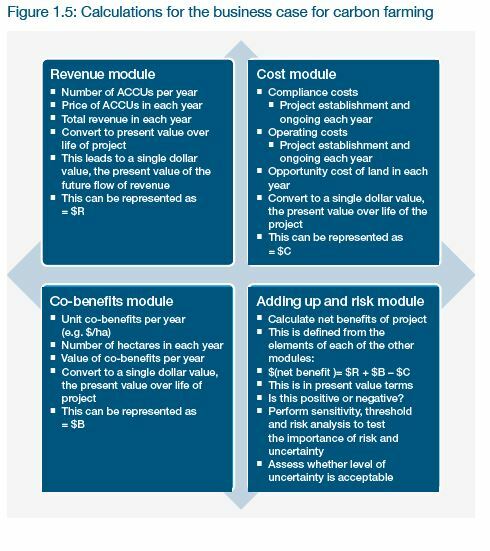
The ultimate objective is to enable you to fill out the modules of a business case, as illustrated in Figure 1.5.
|
|
|
|
Explore the full Workshop Manual: The business case for carbon farming: improving your farm’s sustainability (January 2021)
Read the report
RESEARCH REPORTS
1. Introduction: background to the business case
This chapter lays out the basic background and groundwork of the manual
RESEARCH REPORTS
1.2 Being clear about the reasons for participating
Introduction: background to the business case
RESEARCH REPORTS
1.4 Working through the business case for carbon farming
Introduction: background to the business case
RESEARCH REPORTS
1.5 Factors determining project economics
Introduction: background to the business case
RESEARCH REPORTS
1.8 Important features of the business case
Introduction: background to the business case
RESEARCH REPORTS
2. How carbon is farmed under the ERF
This chapter considers in detail the activities that constitute carbon farming
RESEARCH REPORTS
2.5 Carbon farming under the Emissions Reduction Fund
How carbon is farmed under the ERF
RESEARCH REPORTS
3. The policy context and the price of ACCUs
This chapter takes a broad look at the policy context for carbon farming